Sauna and Cold Plunge: Why the Contrast Works
The cold half of this tradition is older than the marketing around it.
Long before anyone filmed themselves getting into an ice barrel, Finns were rolling in snow and stepping into lakes between sauna rounds, and Russians, Estonians and Scandinavians were doing their own versions. The pairing is not a wellness trend. The trend is the part where it became content.
If you are planning a home sauna, this is worth deciding early, because it changes your layout and your budget.
What actually happens
Heat opens your blood vessels. Cold closes them, fast. Going from one to the other is a strong physiological event, which is precisely why people find it striking, and precisely why it deserves respect rather than bravado.
The subjective experience is consistent enough that it is worth describing plainly: the cold is unpleasant for perhaps twenty seconds, then it stops being unpleasant, and what follows is a distinct sense of clarity and calm that most people find is the whole reason they keep doing it.
Whether that feeling reflects a lasting physiological benefit is, as with most of this field, less settled than the internet suggests. We wrote separately about what the sauna research actually says, and the same caution applies here. Cold exposure is an active research area, much of the work is small, and nobody should be promising you outcomes.
Do it because the feeling afterwards is worth it. That is a sufficient reason.
How the rotation usually goes
There is no single correct protocol, and anyone giving you an exact one with precise numbers is inventing it.
What people commonly settle into:
- Sauna, 10 to 20 minutes. Until you are properly hot, not until you are suffering.
- Cold, 1 to 3 minutes. Shorter at first. Much shorter.
- Rest, 5 to 10 minutes. Dry off, sit down, let your body come back on its own.
- Repeat two or three times, if you want to.
Two things matter more than the numbers. Get out of the cold before you want to, especially in the beginning. And let your body rewarm by itself rather than jumping straight back into the heat, because that recovery period is part of the effect rather than dead time.
Many people finish on heat rather than cold, simply because it is more pleasant to end warm.
Safety, which is not optional here
The contrast is stronger on your cardiovascular system than either half alone. That is the point, and it is also the risk.
Talk to your doctor first if you have any heart condition, high or low blood pressure, are pregnant, or take medication affecting your heart, blood pressure or circulation. Cold water immersion is not a neutral activity for a compromised heart.
For everyone:
- Never after drinking alcohol. Not one glass.
- Never alone, at least while you are learning what your reaction is.
- Enter the cold gradually. Do not jump or dive. The cold shock response makes you gasp involuntarily, and gasping underwater is how people drown in water they could easily have stood up in.
- Breathe out slowly as you go in. It is the single most effective thing for controlling the gasp.
- Start warmer and shorter than you think you need. 60°F for thirty seconds is a perfectly respectable beginning.
- Get out at once if you feel dizzy, if your chest tightens, or if you stop shivering when you should be shivering.
Nobody is impressed by how long you stayed in. The people who do this for years are the ones who did it carefully.
Setting it up at home
The simplest version costs nothing. A cold shower after your sauna. Not as dramatic, and genuinely most of the effect. Start here before you spend money, and find out whether you actually like the contrast.
The next step is a dedicated plunge tub. Ours are in cold plunge and hot tubs. What separates them is chilling and filtration: a tub that chills and circulates holds a stable temperature and stays clean, and one that does not is a barrel you refill with ice, which is cheap to buy and tedious to live with.
Three practical questions before you buy:
Where does it drain? You will empty it periodically. Plan for that before it is in place, not after.
What does it sit on? Full of water, a plunge tub is heavy. A deck needs to be rated for it.
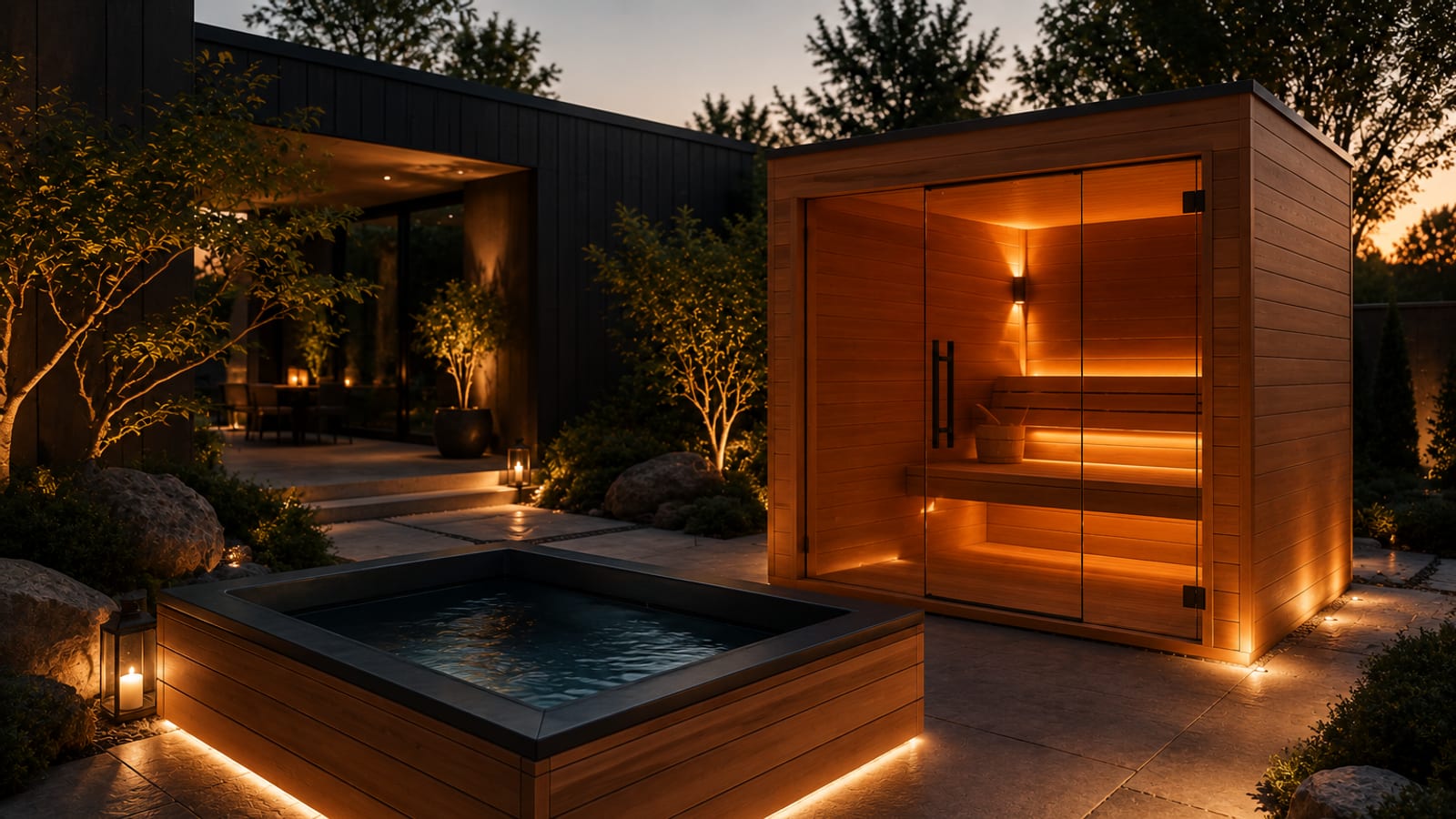
Is it near the sauna? The walk between the two, in a towel, in February, is what decides whether you keep the routine. Ten steps is a habit. Across the garden and round the house is not.
Layout, if you are planning both
The pair works best when the sequence is short and obvious: sauna, then cold, then somewhere to sit.
That third element is the one people forget. The rest phase is where the feeling everyone describes actually arrives, and if there is nowhere to sit you will go back inside and lose it. A bench, two chairs, a covered corner. It costs very little and it is the difference between a routine and a novelty.
If you are building outdoors, this is also the argument for a cabin with a porch or a changing room rather than the smallest cabin that fits. We compared the options in indoor vs outdoor saunas.
What it costs
Prices from our own collection at the time of writing.
| A cold shower | nothing |
| Cold plunge tubs and hot tubs | see the collection, 13 models |
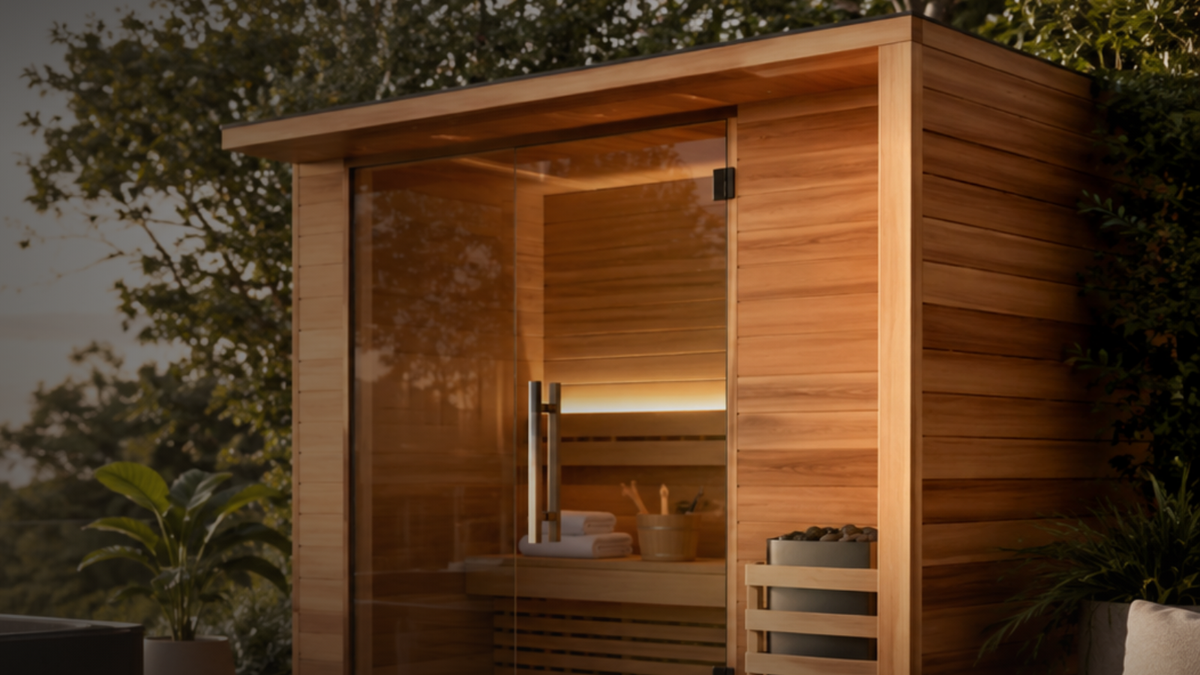
| Outdoor sauna to pair with one | from $4,890 |
| A place to sit between rounds | a bench and some thought |
The honest advice: do not buy both at once. Get the sauna, use a cold shower for a couple of months, and find out whether the contrast is something you actually reach for. Plenty of people discover they love the sauna and can happily skip the cold. Better to learn that before buying a chiller.
Common questions
Do I have to do the cold part?
No. A sauna is worth having on its own. The contrast is a tradition, not a requirement.
How cold should the water be?
Colder is not better, it is just colder. Many people settle somewhere in the 50s Fahrenheit. Start warmer, and let your tolerance find its own level.
How long should I stay in?
Less than you think, especially at first. Thirty seconds to a minute is a real session. Ambition here has no upside.
Sauna first or cold first?
Sauna first is the traditional order and the one most people prefer. Some finish on cold, most finish on heat.
Can I use a cold plunge without a sauna?
Yes, plenty do. You lose the contrast, which is the part most people are actually chasing.
Does the cold cancel out the sauna?
No. Alternating is the traditional practice, not a mistake to avoid.
What about ice baths versus a chilled tub?
Ice works and costs nothing but your time. A chiller costs money and removes the tedium of hauling ice, which is the reason most ice-bath routines quietly stop after two months.
Where to start
If you have not chosen a sauna yet, begin with the complete home sauna buying guide.
If you want the honest version of what heat is and is not understood to do, read sauna benefits: what the research actually says.
And if you are planning a garden setup with both, tell us the space you have and we will tell you what fits, including when the answer is to start with the sauna alone.