The Complete Home Sauna Buying Guide
A home sauna is a considered purchase. Most cost between five and twenty-five thousand dollars, they are difficult to move once installed, and the specification decisions are made before delivery, not after.
This guide walks through the decisions in the order they actually matter. Work through it once and you will know what you are looking for before you look at a single product page.
1. Start with where it goes
Not with the model. Not with the brand. With the space.
Indoors means a basement, a spare room, a large bathroom or a garage. You gain year-round convenience and a short walk from the shower. You take on floor protection, ventilation, ceiling height and getting the panels through your doorways.
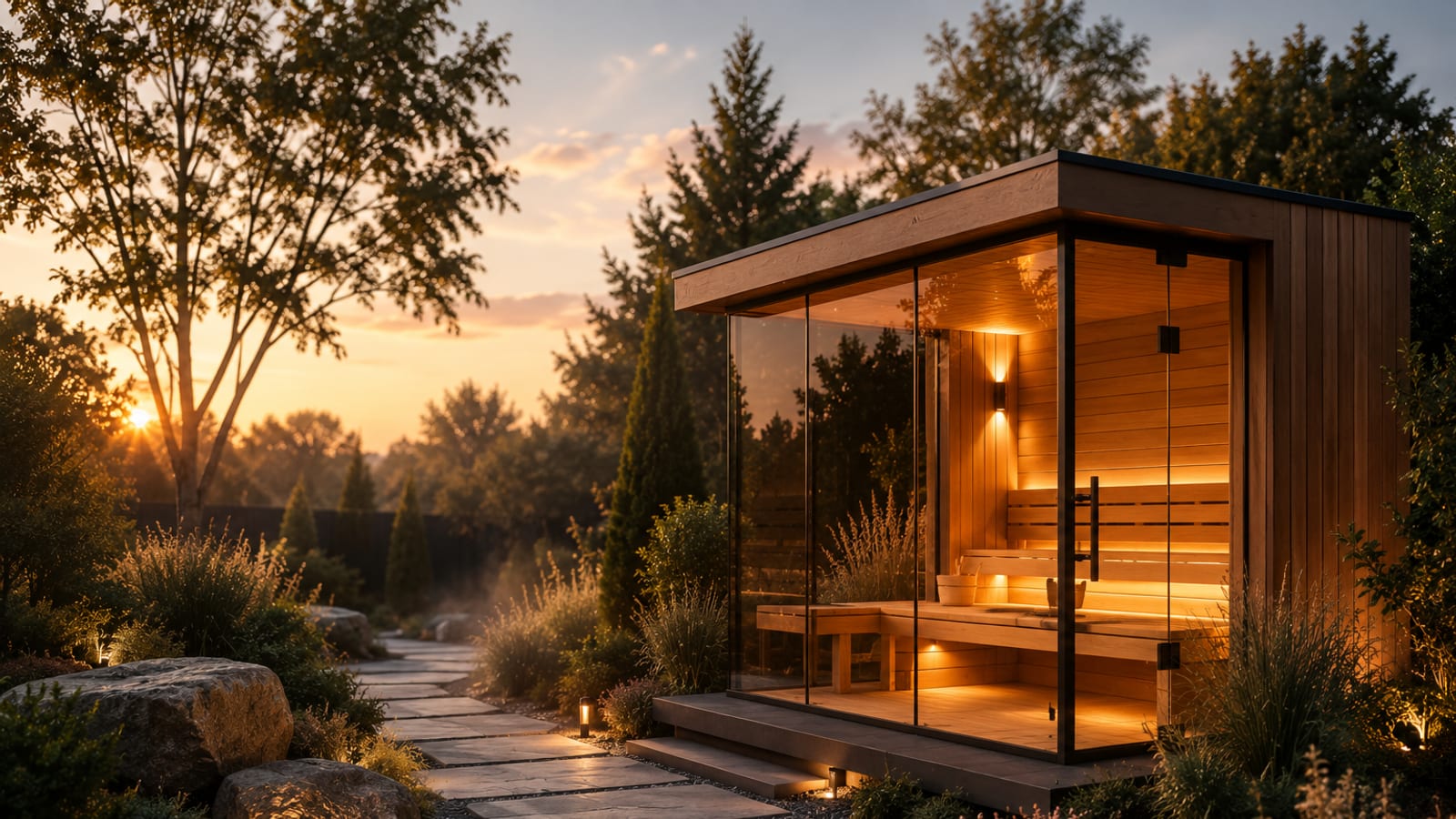
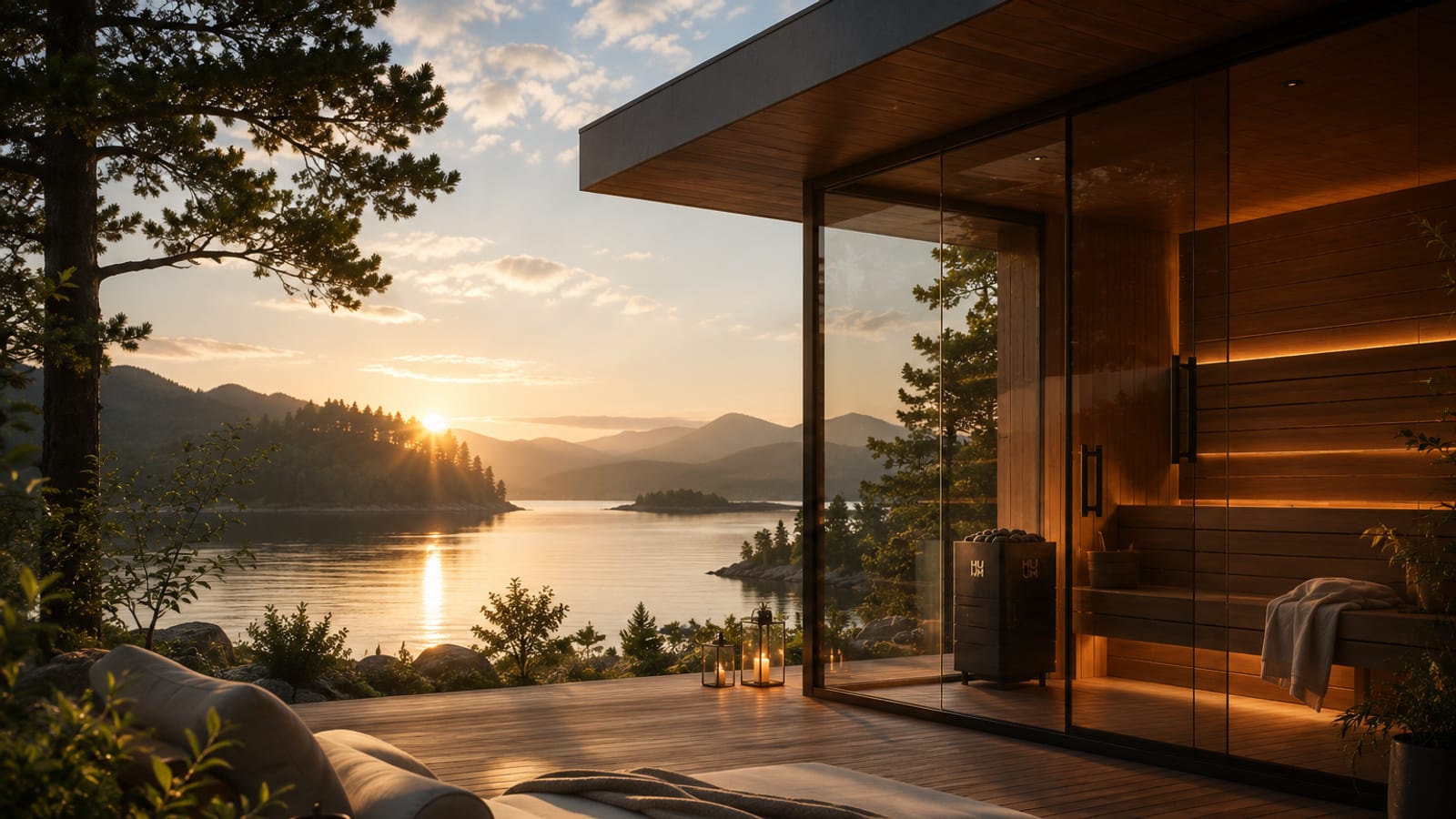
Outdoors means a patio, a deck or a garden. You gain the experience, the view, the fact that it does not consume a room. You take on a level foundation, weather exposure, an outdoor-rated electrical run, and a walk through the cold in February. Many owners will tell you that walk is part of the appeal.
Measure the space before anything else. Note the ceiling height, and check the width of every door and stairway the cabin has to pass through on its way in. Delivery crews will not resolve this for you on the day.
We cover this decision in depth in indoor vs outdoor saunas.
2. Decide how many people it needs to hold
Be honest here, because oversizing costs money twice: once at purchase and again on every electricity bill.
One to two people. Compact, quick to heat, cheapest to run. A one-person Finnmark FD-1 starts at $4,695 and a two-person FD-2 at $5,995. Right for a single user or a couple who use it separately.
Three to four people. The most common household choice. It fits a couple comfortably with room to stretch out, and it takes friends. The FD-3 is $6,495, the four-person FD-4 Trinity is $7,795.
Five or more. Genuinely social. Slower to heat, more expensive to run, and worth it if you will actually fill it. The FD-5 Trinity XL is $8,995, and larger outdoor cabins go well beyond that.
A practical rule: count the people who will realistically be in it on a normal week, add one, and stop there. Buying for the party you host twice a year means heating empty benches the other fifty weeks.
3. Choose your heat
This is the decision people agonise over most, and it comes down to which experience you want rather than which is objectively better.
Traditional heats the room to 150-195°F with a stove and stones. Pour water over the stones and you get löyly, the wave of steam that defines the Finnish sauna.
Infrared heats your body directly with radiant panels at 120-150°F. The air stays cooler and easier to breathe, and it is ready in 10 to 20 minutes rather than 30 to 45.
Combination cabins carry both in one room, which is the right answer for households that genuinely want each on different days.
Our full comparison is here: infrared vs traditional sauna. Browse infrared saunas or traditional saunas once you have decided.
4. Check your electrical supply before you buy
This is the step most often skipped, and the one most likely to cause an expensive surprise.
Traditional heaters are commonly 4.5 to 9 kW and almost always need a dedicated 240V circuit run by a licensed electrician. Smaller infrared cabins sometimes run on a standard 120V outlet, while larger and full-spectrum models often need 240V too.
Three things to do before you order:
- Read the electrical specification for the exact model, not the range
- Look at your panel and find out whether it has capacity
- Get a quote from an electrician for the run to where the sauna will sit
That last figure belongs in your budget from the beginning. A $5,000 sauna with $1,800 of electrical work is a $6,800 project, and it is better to know that now.
5. Understand the wood
Sauna wood is chosen for how it behaves under repeated heat and humidity, not for looks alone.
Cedar is the classic. Naturally resistant to moisture and decay, aromatic, and it stays comfortable to touch at high temperature. It is the premium choice and it is priced accordingly.
Hemlock is dimensionally stable, largely odourless, and lighter on the budget. A sensible pick if cedar's scent is not something you want.
Thermally modified aspen has been heat-treated to improve its stability and moisture resistance. Pale, clean-looking and very well suited to outdoor use.
Spruce appears in Scandinavian-style kits and gives a lighter, brighter interior.
Whatever the species, what matters is that benches and backrests stay comfortable to sit on when the room is at temperature. Any sauna built properly for the purpose will handle that. It is a reason to buy a sauna rather than a heated shed.
6. Size the heater to the room, not to ambition
For traditional saunas, the heater must match the room volume. Undersized and it never quite reaches temperature. Oversized and it cycles hard, wastes energy and can overheat the surfaces near it.
Manufacturers publish a recommended room volume for every heater and that figure is the one to trust. Uninsulated walls, glass fronts and outdoor placement all push the requirement upward.
We carry heaters and controllers from Harvia, HUUM and others in sauna heaters and equipment. If you are buying a cabin and heater separately, confirm the pairing before you order rather than after.
7. Set a realistic budget
Prices below are from our own collection at the time of writing.
| What you are buying | Realistic starting point |
|---|---|
| One-person indoor infrared | $4,695 |
| Two-person indoor infrared | $5,995 |
| Indoor traditional kit | $4,990 |
| Outdoor barrel sauna | $4,890 |
| Outdoor cabin sauna | $4,990 |
| Infrared and steam combination | $7,795 |
| Premium indoor kit | $17,867 |
| Premium outdoor garden suite | up to $24,900 |
Then add, honestly:
- Electrical work, which is frequently $800 to $2,500 depending on the run
- A pad or foundation for outdoor models
- Freight and any lift-gate or inside-delivery charge
- Accessories you will want on day one: a bucket and ladle, a thermometer, a backrest, and a cover if it lives outdoors
A useful sanity check is to take the cabin price and add twenty to thirty percent. If that total still works for you, you are on solid ground.
8. Think about the cold side
A growing number of owners pair the sauna with a cold plunge, alternating hot and cold. It is the older half of the tradition, not a recent trend, and it is worth deciding early because it affects your layout and your budget.
If it appeals, look at cold plunge and hot tubs while you are still planning rather than after the sauna is installed and the space around it is spoken for.
9. Before you press buy
A short checklist worth running through:
- ☐ The space is measured, including ceiling height
- ☐ Every doorway and stairway on the delivery path is wide enough
- ☐ The electrical requirement is confirmed for that exact model
- ☐ An electrician has quoted the work
- ☐ The foundation or floor protection is planned
- ☐ The heater matches the room volume
- ☐ Delivery method and any extra charges are understood
- ☐ Warranty terms and what they cover are clear
- ☐ The total, not just the cabin price, still works
Common questions
How much does a home sauna really cost, all in?
Take the cabin price and add twenty to thirty percent for electrical work, foundation, freight and first accessories. A $5,000 cabin is realistically a $6,000 to $6,500 project.
Do I need a permit?
For an indoor sauna, usually only for the electrical work. For an outdoor structure, rules vary by city and county, and setbacks from property lines are the usual sticking point. Call your building department before ordering.
Can I assemble it myself?
Most kits are designed for it, and a weekend with two people is typical. The electrical connection is a different matter and in most jurisdictions must be done by a licensed electrician. Doing it yourself can void both the warranty and your home insurance.
How long until I can use it?
Indoors, mainly a question of scheduling the electrician. Outdoors, allow three to four weeks, because a concrete pad has to be poured and cured before delivery.
How often will I actually use it?
The honest predictor is not enthusiasm, it is distance and heat-up time. A sauna near your shower that is ready in fifteen minutes gets used several times a week. One at the end of the garden that takes forty-five minutes gets used at weekends.
What maintenance does it need?
Wipe the benches, let a traditional room dry between sessions, and check the stones every year or two, as they degrade and need replacing. Outdoor cabins need attention to the exterior finish every few years and are much better off under a cover.
Two-person or four-person?
Count who will realistically be in it on a normal week and add one. Anything beyond that is heating empty benches.
On health claims, plainly
You will read a lot online about what a sauna does for the body. Some is supported by research, much is not, and a good deal of it is written by people with something to sell.
We would rather be straight with you. People buy saunas for relaxation, for recovery after training, and for the ritual. Research into cardiovascular and recovery effects is ongoing and interesting, but it is not settled, and a sauna is not a medical device. If you have a heart condition, are pregnant, or take medication affecting blood pressure or heat regulation, talk to your doctor before buying.
Still deciding?
Read infrared vs traditional sauna for the heat decision, and indoor vs outdoor saunas for the placement decision.
Or tell us your room dimensions, your electrical situation and how many people will use it, and we will tell you honestly what fits. Including, when that is the answer, that nothing we sell does.