Article: Infrared vs Traditional Sauna: Which One Belongs in Your Home?
Infrared vs Traditional Sauna: Which One Belongs in Your Home?
Almost everyone shopping for a home sauna hits the same fork in the road. Infrared or traditional? The two are often presented as rivals, as though one had to be better. They are not. They are two different experiences that happen to share a name.
Choosing well is less about which is superior and more about which heat you actually enjoy, and what your house can accommodate.
The one difference everything else follows from
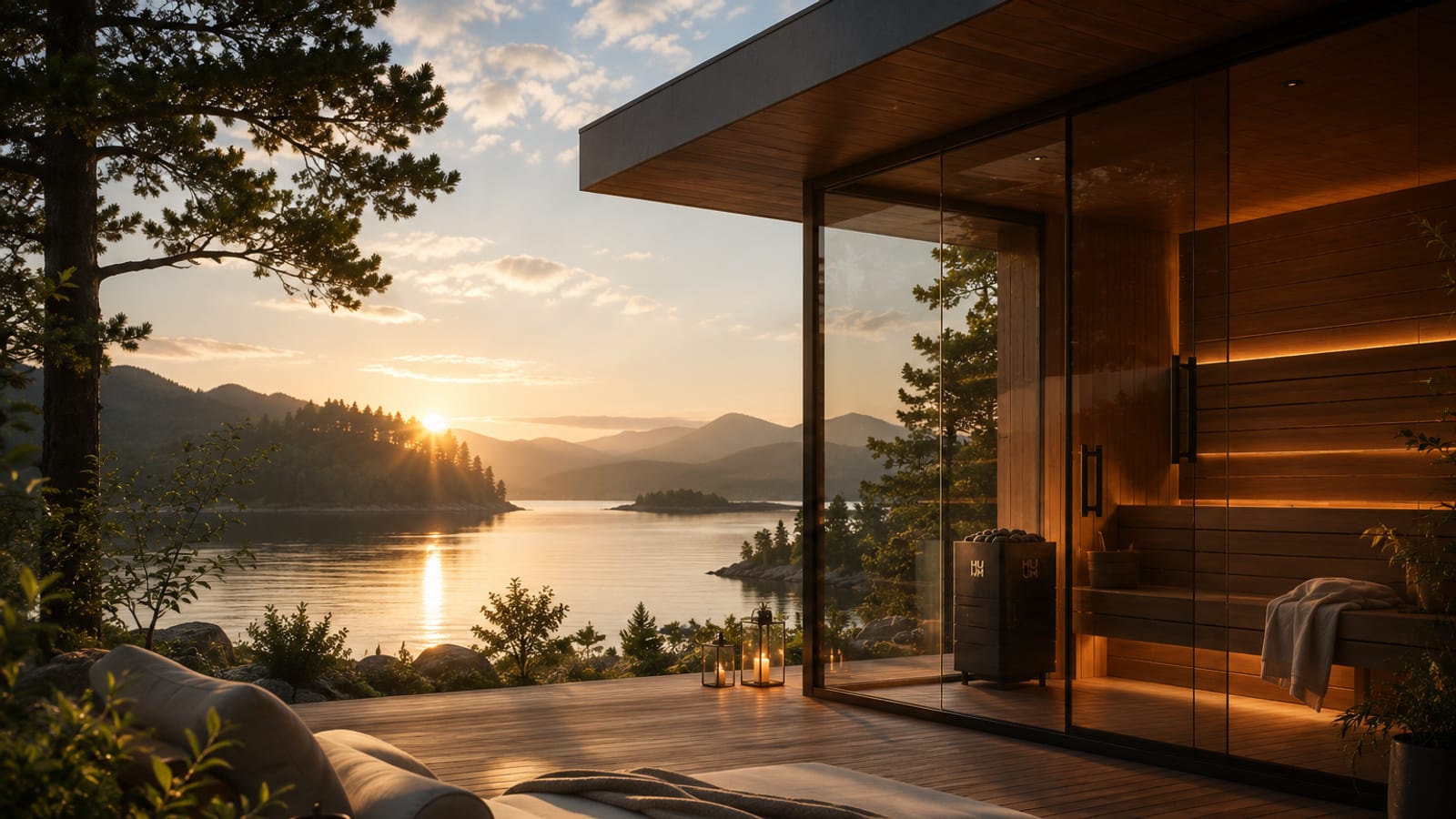
A traditional sauna heats the air. A stove full of stones brings the room to a high temperature, and that hot air warms you.
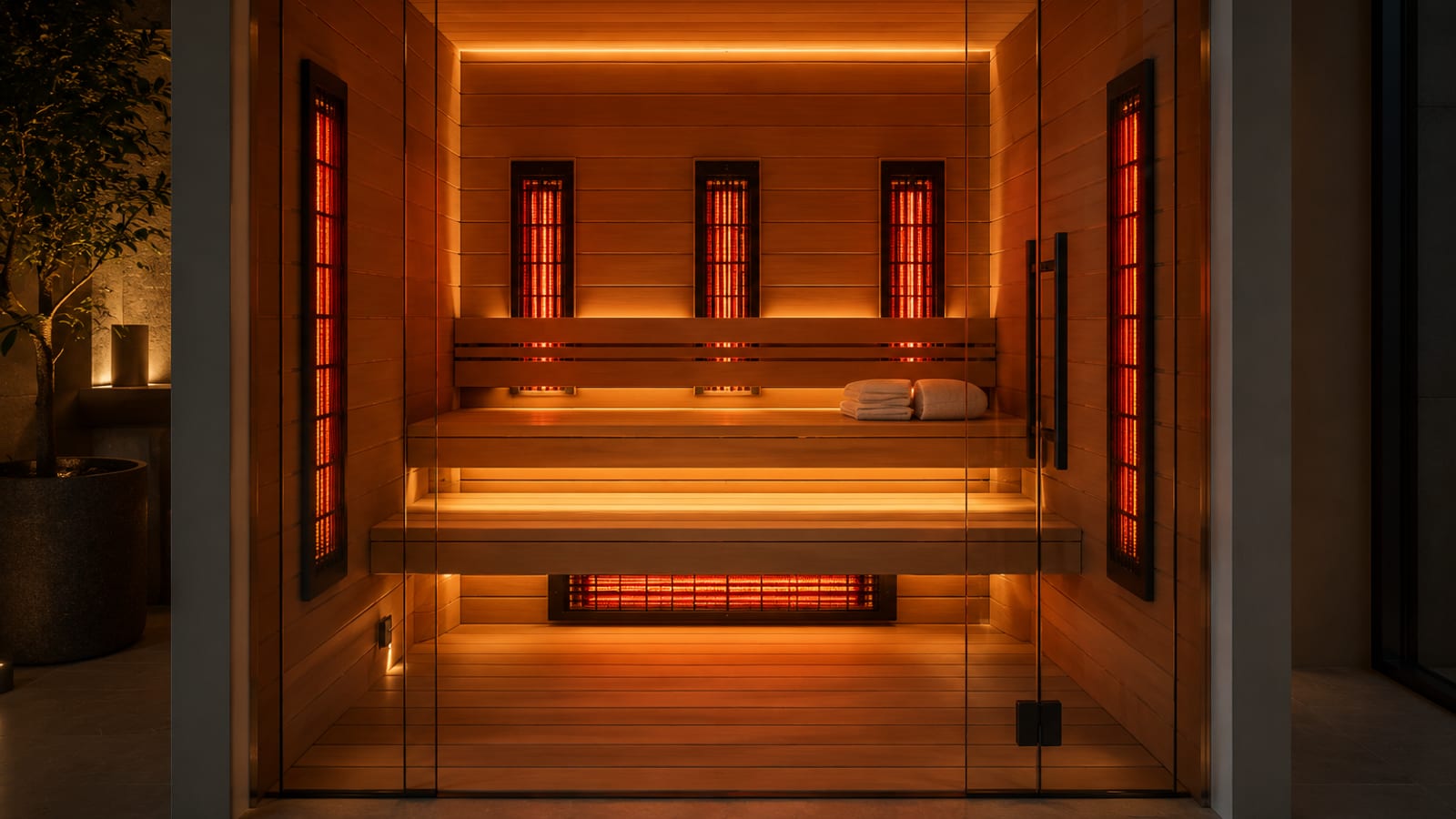
An infrared sauna heats you. Panels emit radiant energy that your body absorbs directly, in much the same way you feel the sun on your face on a cold day while the air around you stays cool.
Every other difference below is a consequence of that single distinction.
Temperature and how it feels
Traditional saunas typically run between 150 and 195°F (65 to 90°C). The air is dry until you ladle water onto the stones, which releases a burst of steam known as löyly. That wave of humid heat is the moment most enthusiasts are chasing. It is intense, enveloping, and it climbs.
Infrared saunas typically run between 120 and 150°F (49 to 65°C). The air stays noticeably cooler and breathing is easier, yet you still sweat heavily because the heat is reaching you directly rather than through the air. Sessions tend to run longer, often 30 to 45 minutes rather than 10 to 20.
A useful way to decide: if you have ever found a hot room hard to breathe in, infrared will suit you better. If the blast of steam is the whole point, only a traditional sauna delivers it.
Heat-up time
This matters more than buyers expect, because it decides how often you actually use the thing.
A traditional sauna needs roughly 30 to 45 minutes to reach temperature. That means planning ahead. Many owners settle into a rhythm of switching it on when they start dinner and using it later in the evening.
An infrared sauna is usable in 10 to 20 minutes, and some of the benefit begins as soon as the panels are warm. If you picture yourself stepping in on impulse after work, that gap is the difference between a sauna you use four times a week and one you use twice a month.
Electrical requirements
This is where a purchase can quietly go wrong, so check it before you fall in love with a model.
Traditional saunas need a heater sized to the room, commonly 4.5 to 9 kW, and that almost always means a dedicated 240V circuit installed by a licensed electrician. Budget for that work. It is not optional and it is not a detail.
Smaller infrared cabins can often run on a standard 120V household outlet, though larger and full-spectrum models frequently require 240V as well. Always read the specification for the exact model rather than assuming.
If your electrical panel is already at capacity, this single point may decide your purchase for you.
Wood, water and maintenance
A traditional sauna is built to handle water. Cedar, hemlock and thermally modified aspen are chosen for how they behave under repeated heat and humidity cycles. You will need to let the room dry between sessions and wipe the benches down.
An infrared cabin stays dry. There is no water on the stones, no steam, and consequently less to maintain. For anyone installing indoors over finished flooring, that dryness is a genuine practical advantage.
What each one costs
Prices below are from our own collection at the time of writing and are a fair reflection of the current market.
Infrared. Our infrared saunas are Finnmark full-spectrum cabins. A one-person FD-1 starts at $4,695. The two-person FD-2 is $5,995, and the three-person FD-3 is $6,495.
Traditional. In traditional saunas, an indoor SaunaLife X2 kit starts at $4,990. Outdoor barrel models begin around $4,890, and premium garden suites reach $24,900. The Kohler C1 indoor kit sits at the top of the indoor range, from $17,867.
The headline figures are closer than people expect. The real cost difference usually appears in installation: the electrical work a traditional sauna requires, and, for outdoor models, the pad or foundation it will sit on.
You do not necessarily have to choose
A category worth knowing about: combination cabins that carry both infrared panels and a traditional steam heater in one room.
The Finnmark FD-4 Trinity seats four and runs $7,795. The FD-5 Trinity XL seats five at $8,995. If you want the quick, gentle infrared session on a weeknight and the full steam ritual on a Sunday, a combination unit is the honest answer rather than a compromise.
There are also combination barrel saunas for outdoor installation, the FD-6 in cedar at $9,995 and the FD-7 in thermo-aspen at $9,495.
What each one costs to run
Manufacturers rarely publish this clearly, so here is how to work it out yourself in thirty seconds.
Take the heater or panel rating in kilowatts, multiply by the hours you run it, and multiply by your electricity rate per kWh. Your rate is printed on your utility bill.
A 6 kW traditional heater running for one hour draws roughly 6 kWh. But it does not draw full power the whole time. It pulls hard while heating up, then cycles to hold temperature, so a realistic figure for a 45-minute heat-up plus a 20-minute session is somewhere around 4 to 5 kWh.
A 2 kW infrared cabin running for a 40-minute session is closer to 1.3 kWh, and it does not need a long pre-heat.
Multiply either by your rate and you will find both are cheaper per session than most people assume, and that infrared is meaningfully cheaper than traditional. Where traditional costs more is in frequency: if you heat the room and then decide not to use it, that energy is spent regardless.
Two factors change these numbers more than the sauna itself: how well the cabin is insulated, and whether it sits indoors or outdoors in winter.
Three mistakes we see repeatedly
Buying for the wrong body. People choose traditional because it is the authentic one, then find the air genuinely uncomfortable to breathe and use it twice a month. If you already know you dislike very hot rooms, believe yourself.
Ignoring the electrical requirement until after ordering. A dedicated 240V circuit is not a detail to sort out later. Check your panel and get a quote before you buy, not after the cabin is in your driveway.
Oversizing. A six-person cabin bought for a two-person household heats four empty seats every session, costs more to buy and more to run. Buy for your normal week.
Common questions
Do you sweat as much in an infrared sauna?
Yes, often more, and it starts sooner. The heat reaches you directly rather than having to warm the air first, so you sweat at a lower ambient temperature.
Can you pour water on the rocks in an infrared sauna?
No. Infrared cabins have no stones and no stove. Water and electrical panels do not mix. If löyly matters to you, you want traditional or a combination cabin.
Which heats up faster?
Infrared, decisively. Ten to twenty minutes against thirty to forty-five.
Is one safer than the other?
Neither is inherently safer. Infrared runs at a lower air temperature, which some people find more manageable, but the same precautions apply to both: hydrate, do not drink alcohol beforehand, and get out when you have had enough.
Can I install either one myself?
Cabin assembly is often within reach of a competent DIYer. The electrical connection is not. In most jurisdictions a dedicated 240V circuit must be installed by a licensed electrician, and doing otherwise can void both your warranty and your home insurance.
Which holds its value better?
Neither is a good investment in resale terms. Buy it because you will use it.
A word on health claims
You will find a great deal written online about what saunas do for the body. Some of it is supported by research, much of it is not, and a fair amount of it is written by people selling saunas.
We would rather be straight with you. Regular sauna use is popular for relaxation, for the ritual of it, and for how people feel afterwards. Research into cardiovascular and recovery effects is ongoing and genuinely interesting, but it is not settled, and a sauna is not a medical device. If you have a heart condition, are pregnant, or take medication that affects blood pressure or heat regulation, speak to your doctor before you buy. That advice applies equally to both types.
So which one?
Choose infrared if you want short notice sessions, you find very hot air uncomfortable, you are installing indoors, or your electrical panel is limited.
Choose traditional if löyly is the experience you are actually after, you enjoy the ritual of heating the room, or you are building outdoors where a barrel or cabin makes sense.
Choose a combination cabin if you genuinely want both and have the budget for it, rather than buying one and quietly wishing you had bought the other.
If you are still weighing it up, our complete home sauna buying guide walks through size, placement and budget in more detail, and indoor vs outdoor saunas covers the other decision most buyers face.
Questions about a specific model and your particular room? Get in touch. We would rather talk you into the right sauna than out of the wrong one after it has been delivered.